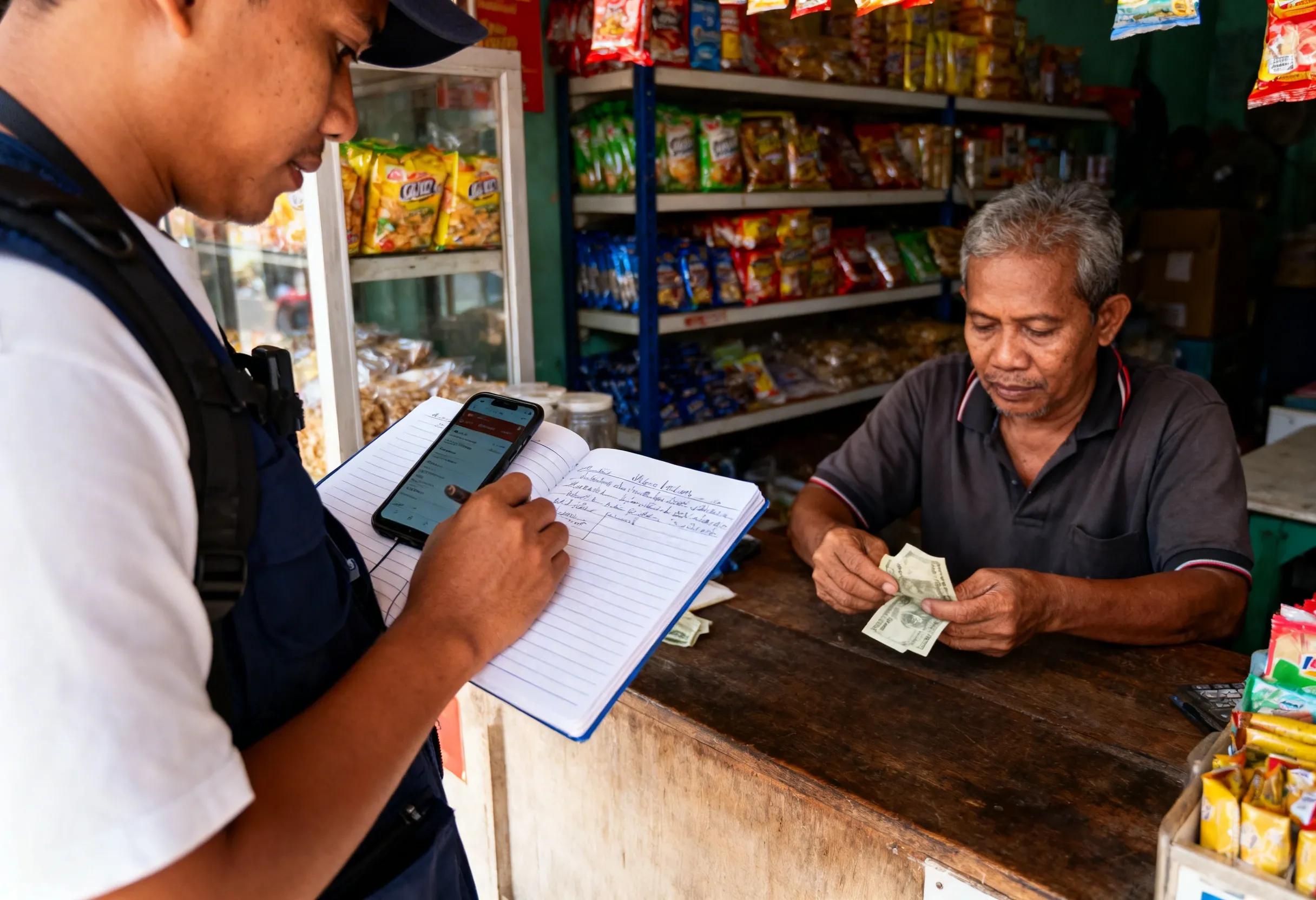
Field collection plays a critical role in maintaining healthy cash flow and minimizing financial risk across the distribution network. By ensuring that outstanding invoices are followed up and resolved, businesses can maintain financial stability across their operations.
This is especially important in Indonesia, where many businesses still rely on traditional distribution channels. It serves as a bridge between billing systems and actual payment transactions.
What is Field Collection?
Field collection is the process of managing billing activities, including invoice, payment tracking, and recovery of overdue payments. It also involves a dedicated collection team that visits customer outlets directly to ensure payments are completed in a timely manner.
Roles of Field Collection Staff
- Follow Up on Overdue Invoice
Field collectors are responsible for conducting direct follow-ups on customers with overdue invoices. This involves visiting customers, confirming outstanding balances, and encouraging timely settlement of payments in a professional and respectful manner. - Record Keeping & Reporting
Accurate documentation is a key responsibility in collecting payments. Staff are required to record all visit details, customer responses, and actions taken during each field visit.
These reports are then submitted to supervisors to monitor progress, evaluate performance, and support decision-making processes. - Legal Compliance
All collection activities must be carried out in full compliance with company policies and applicable laws and regulations. Field collection staff are expected to operate ethically. - Maintain Customer Relationship
Strong communication skills are essential in this role. Staff must be able to engage customers in a calm, respectful, and solution-oriented manner. By reducing tension and building trust, they help create a cooperative environment, increasing the likelihood that customers will fulfill their obligations. - Resolve Issues & Complaints
Teams often encounter various issues raised by customers. They are expected to listen actively, handle complaints professionally, and seek practical solutions whenever possible. - Provide Information & Explaining Consequences
Another important responsibility is to clearly explain the status of overdue payments, including the potential consequences of continued delays. This includes providing transparent information about administrative actions and possible legal implications.
Field Collection Process
The field collection process is designed to streamline collector’s activities. Companies especially in the FMCG industry usually use collection software to increase field collector productivity.
- Account Review
Collection begins with account review using a field collection system or software. The system provides a clear summary of customer accounts, highlighting key tasks, priorities, and recommended actions for the collector. - Visit Planning
Once tasks are clearly defined, the next step is visit planning. Collectors organize their schedule based on assigned accounts. The software also provides the fastest travel paths to each outlet and automatically arranges visit schedules to save time and increase coverage. - Outlet Visit & Negotiations
During visit, collectors engage directly with customers to execute the core collection activities. This includes:
• Confirming the current billing and payment status
• Negotiating suitable payment options based on customer conditions
• Ensuring all actions remain compliant with company policies and regulations - Documentation & Reporting
Every visit must be properly documented to ensure transparency and accountability. When using a field collection system, collectors simply input the visit details, and the system will automatically generate structured reports.
Why Is Field Collection Important in the FMCG Industry?
In many markets, especially in Indonesia, a significant portion of FMCG transactions still happens through General Trade (GT) channels such as local shops and kiosks. These outlets often operate on credit terms, which means payments are collected after goods are sold. Without an effective field collection process, outstanding receivables can quickly accumulate and disrupt the financial cycle of distributors and principals.
Unlike Modern Trade (MT) channels, which are highly structured and supported by digital systems, General Trade operates in a more traditional way. Many GT customers still rely on manual recording and traditional business practices, which increases the risk of delayed payments or incomplete financial tracking. To solve this problem, distributors and principals utilize field collectors to ensure payments are fulfilled.
Common Field Collection Challenges
- Time-Consuming Process
Collecting payments often require multiple steps for each account, from account review and visit planning to on-site engagement and reporting. Because each customer interaction needs to be handled carefully and documented properly, the overall process can become highly time-consuming. This can limit the number of accounts a collector is able to handle in a single day. - Complex Customer Visit Scheduling
Collections are not limited to General Trade, but can also involve Modern Trade. For example, field teams may need to handle invoice exchanges, submit billing documents, or follow up directly with head office teams. - Uneven Workload Distribution
In some cases, certain collectors may be overloaded with accounts and visits, while others have significantly lighter workloads. The uneven workload can lead to inefficiencies and reduced productivity.
Streamline Field Collection with BOSNET Mobile Collector
BOSNET Mobile Collector helps AR teams simplify field collection by providing smart route planning, structured visit schedules, and real-time tracking. Our solutions ensure every collection follows the standardized procedures.
With automated daily task summaries, optimized routes, invoice lists, and performance dashboards for payments and visits, BOSNET Mobile Collector gives full visibility and control over field operations.
Contact us to discover how BOSNET can streamline your collections.
#BOSNET #BestFMCGRunsBOSNET #Distribution #SupplyChain #IncreaseRevenue #ReduceCost