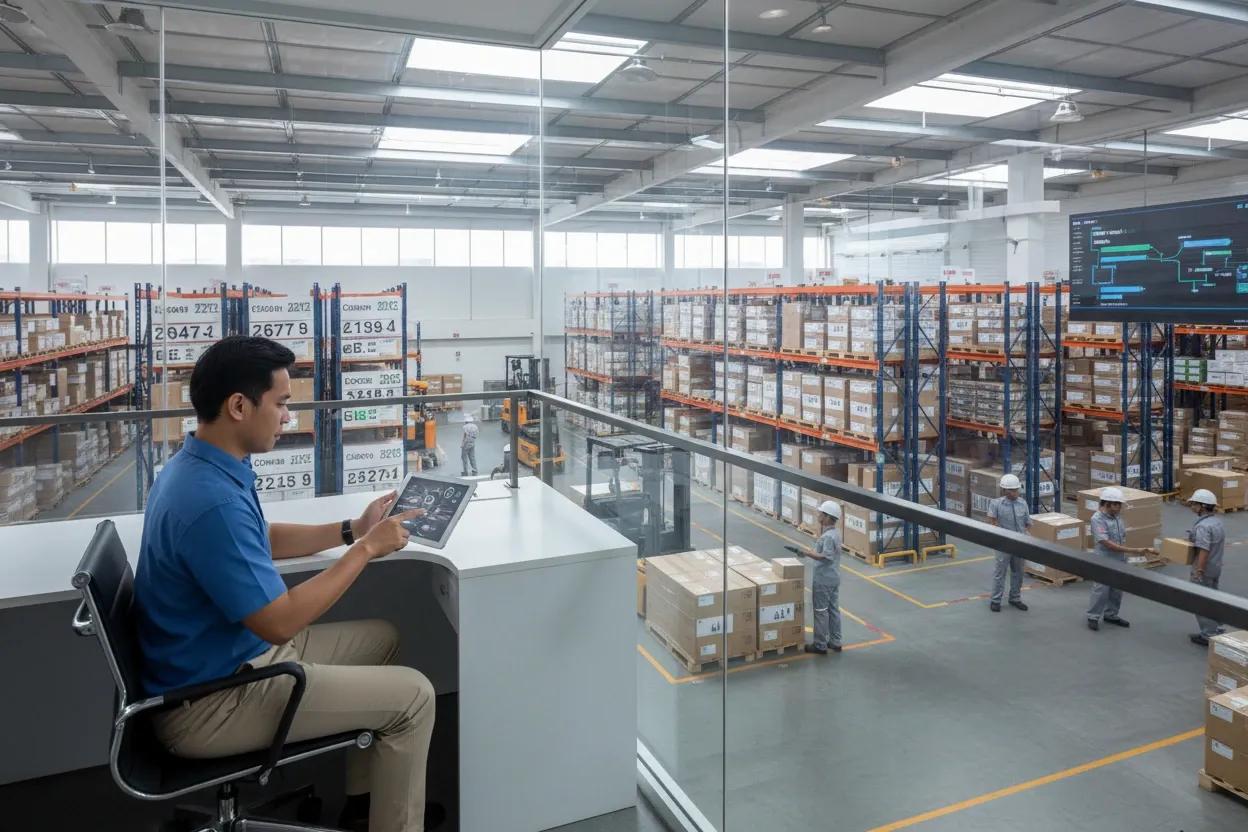
Companies often face challenges when selecting the right ERP software for their business. They often overlook the importance of how a system works in real business operations.
In the FMCG industry, this becomes even more critical. Businesses are moving faster than ever, with products flowing quickly from factories to distributors and then to thousands of retailers. However, many companies still use the wrong software.
What is ERP Software?
ERP (Enterprise Resource Planning) software is an integrated system designed to help businesses automate and manage their core operations in one centralized platform. Instead of using separate tools for different departments, ERP brings everything together in a single system. This includes finance, human resources, manufacturing, supply chain, and sales.
By connecting these functions, the system helps improve operational efficiency, reduce manual work, and ensure that business data remains consistent and up to date across the organization.
Common Mistakes When Choosing ERP Software
Choosing the best ERP software is a critical decision for any business. However, many businesses make mistakes during the selection process.
- Expecting ERP to Solve Everything
One of the most common mistakes is assuming that ERP software can handle every aspect of business operations without limitation.
For example, in distribution, it is often expected to manage end-to-end operational execution. In reality, the software is primarily designed to support planning, coordination, and control. - Ignoring Business Process
Some companies try to use ERP to track field sales activities in detail, even though it is not designed for real-time tracking. As a result, businesses do this process manually.
This is especially common in Indonesia, where many businesses adopt the software as a central system for operations without fully aligning it with how their day-to-day processes actually work. - Underestimating Field Operations
Many distributors rely heavily on field operations as a core part of their daily activities. This includes teams such as merchandisers, salesmen, drivers, and mobile collectors who operate outside the office and require real-time coordination and monitoring.
However, a common mistake is underestimating these operational needs when selecting a software. Not all ERP software is designed to effectively manage field activities. - Choosing Based on Features
Many companies buy too many features that they don’t actually use. When the system is too complex, it becomes harder for teams to use and slows down daily work.
Instead, choose a software that fits your business needs, not the one with the most features. - Integration with Other Systems
The software does not operate in isolation. It often needs to integrate with other systems to support business operations.
Can Distributors Use ERP for Distribution?
ERP software plays an important role in distribution businesses, especially in back-office and planning. With the right system, companies can handle financial reporting, inventory planning, and coordination efficiently.
However, even the best software has its limitations when it comes to field operations.
In distribution, many processes happen outside the office and require real-time execution. ERP systems are not specifically designed to handle these. This often creates gaps such as:
- Field sales teams do not always update data in real time
- Orders are not instantly recorded in the system
- Actual stock does not match match system data
- Delivery route not optimized
- Missed outlet visits
- Difficulty in monitoring sales activities
Because of these gaps, relying only on ERP may not be enough for distributors. As a result, many distributors, particularly in the FMCG industry utilize a Distribution Management System (DMS).
A DMS is designed to support field operations by enabling real-time data capture, improving coordination between teams, and providing better visibility into daily activities. It helps ensure that sales, distribution, and inventory movements are accurately recorded.
Difference Between ERP Software and Distribution Management System (DMS)
- Focus
ERP software focuses on managing internal business operations such as finance, manufacturing, and supply chain processes. It is designed to support planning, control, and coordination within a business.
In contrast, a DMS focuses on external distribution and market execution. It is built to handle activities that happen in the field, including sales execution, order capture, and distribution across outlets. - Users
Internal teams such as finance, manufacturing, and supply chain typically use ERP systems.
Field sales teams, distributors, and sales managers rely on a DMS to manage day-to-day market activities. - Promotions
ERP systems are not designed to manage complex or large-scale promotions in detail.
Meanwhile, a DMS is specifically built to manage and track promotional activities, including schemes, retailer offers, and sales incentives, ensuring better control and visibility over execution. - Route Optimization
ERP software is not designed for daily field execution, especially when it comes to real-time activities like route planning.
A DMS helps plan, track, and optimize efficient routes for field teams, improving store visits and reducing travel time. - Distributor Workflow
Internal processing such as invoicing and dispatch is usually handled within ERP systems.
End-to-end distributor processes, including billing, stock management, returns, and claims are managed through a DMS. - Market Visibility
Data in ERP systems is often updated in batches, resulting in delayed visibility of market activities.
Distribution Management System (DMS), on the other hand, provides live data directly from distributors and sales teams. This allows businesses to monitor market activities as they happen, improving responsiveness and decision-making. - Sales Tracking
ERP software is typically focused on tracking primary sales, from the company to distributors.
A Distribution Management System (DMS), however, provides deeper visibility by tracking secondary and tertiary sales, from distributors to retailers and even further down the distribution chain.
Manage Your Distribution with BOSNET Distribution Management Systems (DMS)
Take full control of your operations with BOSNET Distribution Management Systems (DMS), a digital platform designed to optimize every step of your supply chain. From tracking inventory to monitoring product movement, BOSNET solutions ensure your products reach the right place and time.
Our solutions provide real-time insights into stock levels, delivery schedules, and channel performance. With BOSNET DMS, businesses can minimize delays, reduce costs, and protect your assets by making the entire process efficient and transparent.
Contact us today to see how BOSNET can help you streamline your distribution.
#BOSNET #BestFMCGRunsBOSNET #Distribution #SupplyChain #IncreaseRevenue #ReduceCost