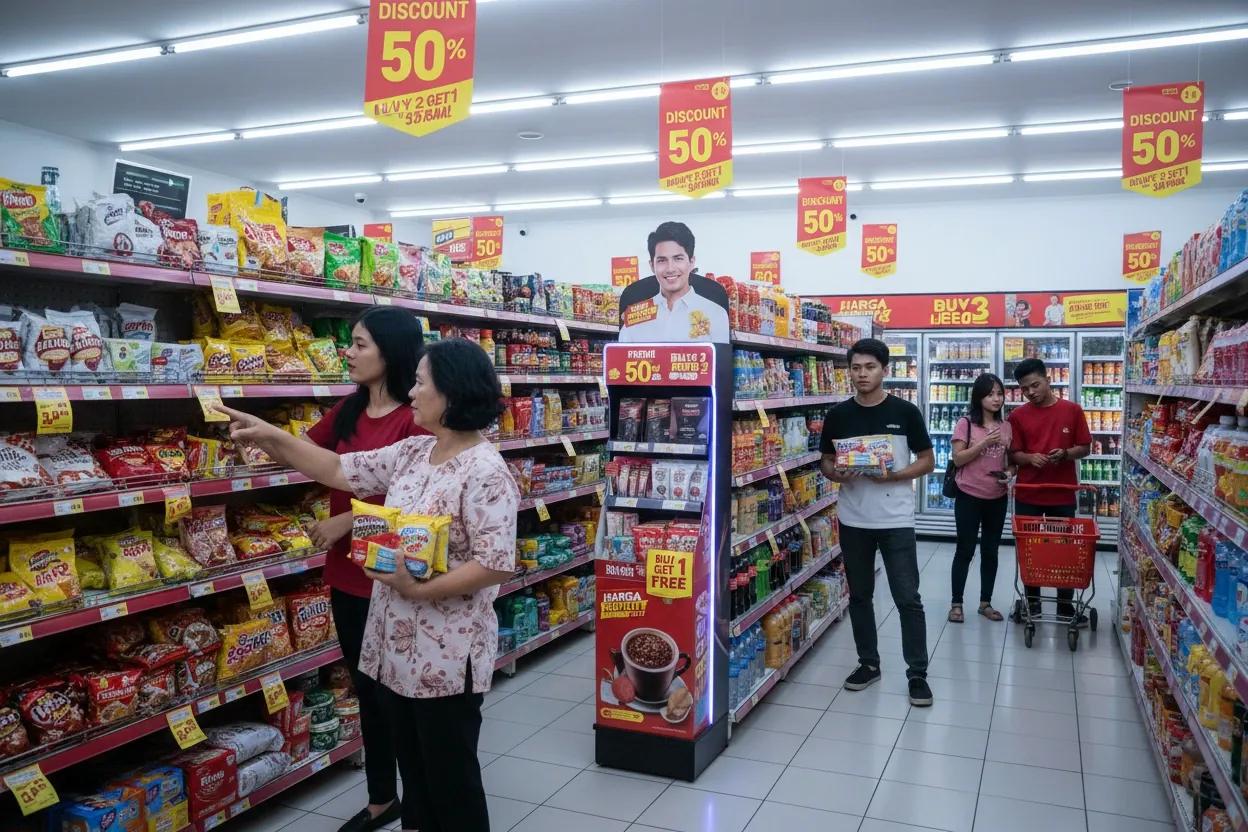
No matter how successful a business becomes, sales promotions remain essential. Well-planned promotional campaigns not only drive short-term revenue but also help businesses better understand customer behavior and market trends.
By analyzing previous campaigns, companies can identify effective strategies, optimal timing, and execution patterns, enabling them to create more data-driven and impactful promotions.
Definition of Sales Promotion
Sales promotion is a marketing strategy where a business runs a temporary campaign or special offer to increase customer interest and product demand. This strategy is commonly used to attract buyers within a certain period and encourage faster purchasing decisions.
Companies often use this approach to introduce new products, move older stock, and increase sales performance. These campaigns are usually planned around key moments such as holiday seasons, product launches, or major shopping events.
This strategy is widely used in the Fast-Moving Consumer Goods industry because market competition is very high. Many brands sell similar products, which makes businesses compete for customer attention and purchasing decisions through attractive promotional campaigns.
Examples of Sales Promotion
There are many ways a business can attract customer attention through promotional campaigns. Below are several common examples of sales promotion strategies used to encourage purchases:
- Flash Sale
A flash sale is a sales promotion strategy that offers discounted prices within a limited period. This method is designed to create urgency and encourage purchase decisions.
Flash sales are usually held with a specific time limit, such as a countdown timer or a 24-hour promotion. Because the offer is only available for a short time, customers are encouraged to buy before the promotion ends. - Bundles
Bundle promotions offer several products together in one package. The items are usually related or belong to the same product category. - First Purchase
Special promotions for first-time buyers are commonly used to attract new customers. Businesses may offer discounts, free shipping, or exclusive deals for the first transaction. - Coupons and Vouchers
Coupons and vouchers are promotional tools that provide discounts or special offers for customers. Businesses often use them to reward loyal customers and encourage future purchases.
These promotions can be distributed through email campaigns, mobile applications, online stores, or printed materials. - Buy One Get One
Buy One Get One (BOGO) is a promotion in which customers purchase one product and receive another for free. BOGO promotions are flexible and can be adjusted based on business needs. For example, companies may offer buy two get one free or similar variations. - Loyalty Program
A loyalty program is a sales promotion strategy that rewards customers for repeated purchases. One of the most common approaches is giving loyalty points for every transaction.
This strategy is widely used in the Fast-Moving Consumer Goods industry to build long-term customer relationships and encourage repeat purchases. Loyalty points can also increase the total value of customer spending over time.
Sales Promotion Function
Sales promotions can run across a wide range of channels, from social media and email to a brand's own website. Each channel offers a different way to reach the right audience at the right time. And depending on the goal, a promotion can serve several distinct functions.
- Introducing New Products
Campaigns are often used to introduce new products to the market. Businesses may offer special discounts, free samples, or limited-time deals to attract customer attention during a product launch. - Accelerating the Sales Cycle
Sales can encourage customers to make purchasing decisions faster. Flash sales and exclusive deals create urgency, motivating buyers to complete transactions within a limited time. - Increasing Sales Volume
One of the main functions of sales promotion is to increase sales volume within a shorter period. Promotions such as bundles, discounts, and Buy One Get One offers encourage customers to purchase larger quantities of products. - Attracting New Customers
Beyond serving existing buyers, promotions open the door to people who have never purchased from a brand before. A compelling offer can be the first touchpoint that turns a stranger into a customer, and eventually, a loyal one.
Risk of Implementing Sales Promotion
Although sales promotions offer many business advantages, they also entail several risks that companies need to consider. Without proper monitoring, research, and software analysis, promotions can create operational and financial challenges.
- Misleading Data
A sudden increase in sales does not always indicate long-term customer loyalty. In many cases, customers purchase only because of the discount, then stop buying once the promotion ends.
Without accurate data analysis, businesses cannot properly measure ROI or understand whether the promotion truly delivers measurable impact. - Erosion of Profit Margin
Frequent discounts can reduce revenue and profit margins. Poor pricing strategy can also create customer expectations for continuous discounts, making it difficult to maintain regular pricing after the promotion period ends. - Brand Devaluation
Running promotions too often, too aggressively, or at the wrong time can make a product appear cheap or low-quality. Customers may begin to view the brand as low-quality or assume the product struggles to sell at its usual price. - Stockouts
During promotional periods, demand can increase rapidly, leading to shortages. If inventory levels are not properly forecasted before the campaign begins, businesses may run out of stock while the promotion is still active. This can lead to lost sales opportunities, delayed fulfillment, and customer dissatisfaction.
To reduce stockout risks, businesses should forecast demand before launching promotions and continuously monitor inventory throughout the campaign. Warehouse Management System (WMS) helps businesses track stock movement in real time, allowing faster replenishment decisions and better inventory control during high-demand periods.
How to Create a Sales Promotion Plan
- Plan Your Target Market
Before creating a promotion, businesses need to clearly identify their target market.
By analyzing customer databases, businesses can identify important insights such as:
• Customer age groups
• Geographic areas
• Purchasing frequency
• Product preferences
• Shopping patterns - Determine the Right Time to Run Promotion
Timing plays an important role in sales promotions. A promotion usually generates better results when it includes a sense of urgency or aligns with seasonal purchasing behavior.
For example, businesses often launch promotional campaigns before Eid, national holidays, year-end shopping periods, or other major celebrations. - Utilize Software to Plan and Monitor Sales Promotion
Managing promotions across multiple outlets can become difficult without proper monitoring tools. Distributors and principals often face challenges in tracking whether promotional materials are properly displayed, implemented, or removed after the campaign period ends.
Because of this, businesses usually rely on merchandiser teams to visit stores and monitor promotional execution directly in the field.
With merchandiser software, field teams can record and report store visit activities digitally, including:
• Promotion installation & removal
• Product display conditions
• Store compliance checks
• Photo documentation from outlets
At the same time, distributors and principals can monitor reports and promotional activities directly through a Distribution Management System (DMS). Real-time visibility enables businesses to view store visit reports, promotional execution, outlet conditions, and field activities from multiple locations in a single platform.
BOSNET Solutions for Managing and Monitoring Sales Promotion
- Mobile Merchandiser
BONSET Mobile Merchandiser helps businesses manage and organize field merchandising across outlets and retail locations. The app records each store visit digitally. It includes GPS and geotagging to verify field activity locations.
Merchandisers can also capture shelf and promotional display photos in real time, making it easier for companies to monitor in-store execution across multiple outlets.
Through the application, merchandisers can report promotional installations, removals, product visibility, and other field activities directly from the store visit location. - Distribution Management System (DMS)
BOSNET Distribution Management System helps companies monitor sales promotion activities through a centralized dashboard connected across principals, distributors, and field teams.
The platform allows businesses to view reports, outlet activity, merchandising execution, inventory movement, and sales performance in real time within a single integrated system.
150+ Renowned Brands Trust BOSNET for Their Distribution
Over 150 brands rely on BOSNET to efficiently manage their distribution and sales processes. BOSNET provides an end-to-end solution for distributors to track operations, performance, and sales in real time.
Contact us to see how BOSNET can streamline your operations and deliver real-time visibility across your distribution network.
#BOSNET #BestFMCGRunsBOSNET #Distribution #SupplyChain #IncreaseRevenue #ReduceCost